From the archive · A retrospective
Israel’s Spies Saw the Armies Moving. Their Report Still Said War Was Unlikely.
AMAN’s October 5, 1973 assessment described emergency deployments and Soviet evacuations, then assigned a low probability to an Egyptian attack. The invasion began the following afternoon.
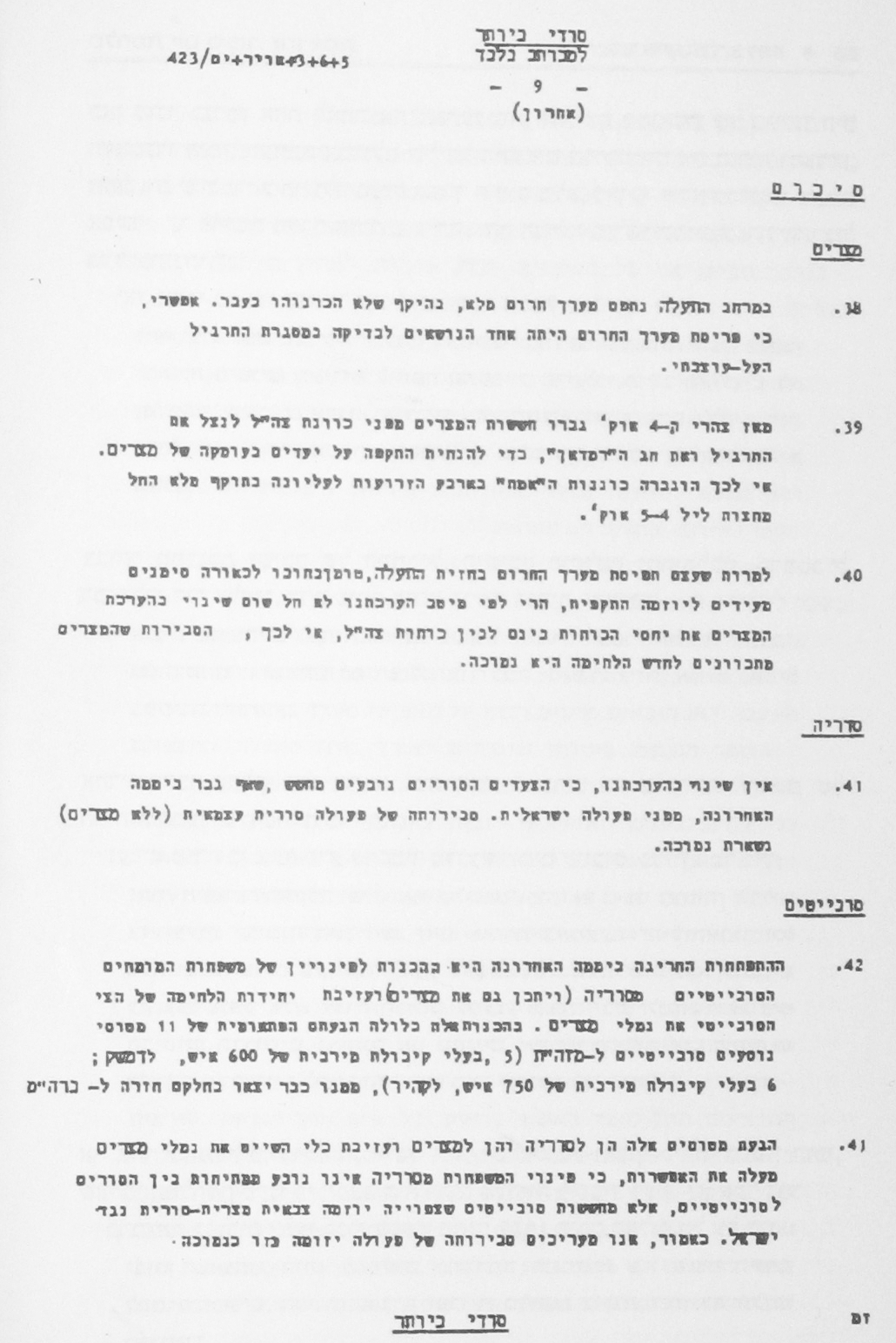
Israel’s military intelligence service had the warning signs on paper. Egyptian forces were on an emergency footing. Soviet families were leaving Syria and Egypt. Soviet naval vessels were leaving Egyptian ports. The assessment still concluded that an Egyptian war was unlikely.
The surviving summary from October 5, 1973, is blunt. Its Egypt section acknowledges that the deployment along the canal could appear to signal an offensive. It then explains that Egypt continued to regard the balance of forces as unfavorable and rates the probability of war as low.
The research branch finished the broader assessment at 11 a.m. and distributed it at 1:15 p.m., according to the archival description accompanying the released scan. The nine-page document contained 43 sections. Thirty-seven described military readiness and the Soviet evacuation; six concluding sections interpreted that information.
Those conclusions supplied reassuring explanations. Egyptian emergency preparations were fitted into the framework of a large exercise. Heightened air-force readiness was attributed to fear that Israel might exploit the exercise and a religious holiday to attack.
The Syria section likewise maintained that Syrian measures reflected fear of Israeli action. It assigned a low probability to Syria initiating hostilities independently of Egypt. The Soviet evacuations received their own section: a possible explanation involving joint Egyptian-Syrian action appeared, with its probability assessed as still lower.
Later on October 5 came a separate warning connecting departing Soviet personnel to Egyptian and Syrian plans for war. The Times of Israel’s review of declassified records dates its arrival to 4:45 p.m. and describes a delay of more than ten hours in transmitting it to the government.
An officer told the Agranat Commission he had been informed that intelligence chief Eli Zeira ordered that message held. Zeira said he did not remember giving the order and suggested retrospectively that he might have hoped for more significant intelligence. The documented dispute preserves both the accusation and his response.
Egypt and Syria attacked at 2 p.m. on October 6. The government established the Agranat Commission on November 18 to investigate prewar intelligence, its interpretation and military preparedness. The Defense Ministry archive records a final report of more than 1,500 pages. The earlier assessment fills one sheet: the armies’ preparations had been observed, categorized and explained in terms that left war unlikely.
The assessment summary and the later warning were separate documents. Zeira disputed personally ordering the later warning held.
Sources & further reading
- Declassified golden communique and YomKippur intelligence failureThe Times of Israel
- Defense Ministry Archive: establishment and scope Agranat CommissionIsrael Ministry of Defense Archive
- AMAN assessment summary, 5October1973, IDF released scanWikimedia Commons / attributed archival documents
SPY REGISTER MEMBERSHIP
Stay on the case.
Follow this story through the case files, read The Brief and keep your own saved reports.
$6.67 a month equivalent · $80 billed annually. Or $8 monthly.
Get the member edition →Renews automatically. Cancel renewal online.