From the archive · A retrospective
Britain Built Colossus to Read Hitler’s Messages. Then It Smashed Eight Machines.
The electronic breakthrough at Bletchley Park outlived the war inside GCHQ—and remained hidden from the people writing computing history.
Eight of the ten Colossus machines were destroyed after the Second World War. Their designer, Tommy Flowers, was ordered to surrender the documentation. Britain had built an extraordinary electronic codebreaking system and then deliberately dismantled most of it.
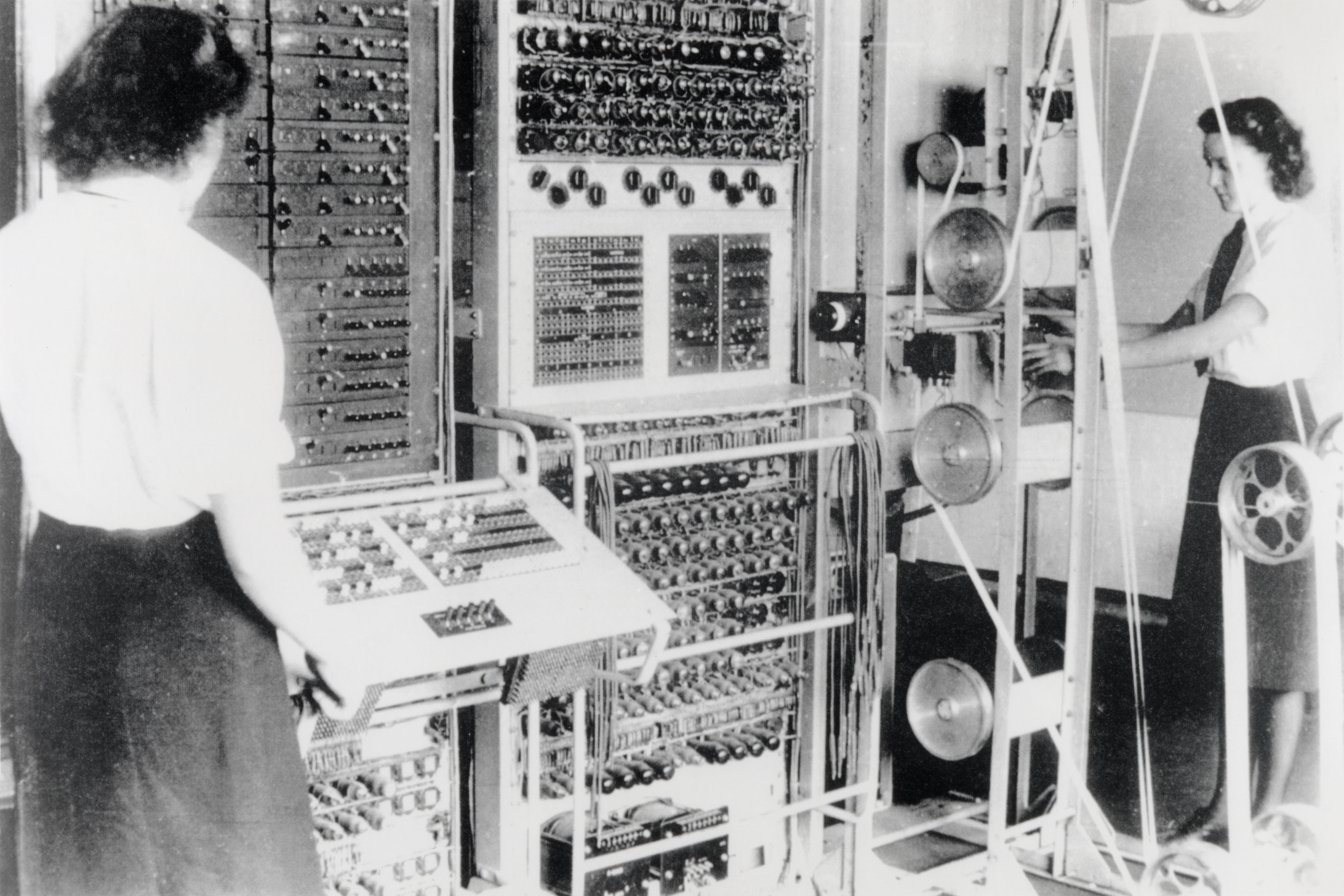
GCHQ’s 2024 release of rare photographs makes the surviving machinery especially striking: one image shows Colossus still at the agency in Cheltenham in 1963. The technology remained useful into the early 1960s, the agency says. Engineers repaired a secret computer whose purpose could be concealed even from the people keeping it running.
Flowers had built the machine at the Post Office Research Station in Dollis Hill. According to the National Museum of Computing, the work took eleven months. The first Colossus arrived at Bletchley Park around the turn of 1944 and was operating by early February.
Its target was Lorenz, the system used for high-level German teleprinter traffic. Colossus searched for settings of the cipher machine’s wheels. Punched paper tape carried the intercepted text; thousands of electronic valves accelerated the statistical work needed to make the messages readable.
That distinction matters when Colossus is described as an early computer. Its programmability was limited and its purpose specific. The museum calls it the first machine combining digital operation, electronics and programmability, while distinguishing it from the stored-program computers that followed.
By the end of the war, the museum says, ten machines helped a workforce of 550 decrypt 63 million characters of high-grade German communications. This opened a channel into the strategic exchanges of the enemy’s senior command.
The achievement came with a long personal cost. Flowers and his colleagues had to keep quiet, and their work spent decades outside the public history of computing. GCHQ’s later disclosures restored a picture of engineers building machines whose significance their own contemporaries could scarcely discuss.
A working reconstruction eventually required a reverse journey through that secrecy. Tony Sale’s team began in 1992, assembling its understanding from fragments of diagrams, photographs and memories. The rebuilt Colossus now stands at the National Museum of Computing, on the site where the wartime machines worked.
GCHQ and the museum describe different stages of public disclosure: initial information emerged in the 1970s, with fuller technical disclosure later. The article avoids assigning a single reveal date.
Sources & further reading
- GCHQ celebrates 80 years of ColossusGCHQ
- ColossusThe National Museum of Computing
SPY REGISTER MEMBERSHIP
Stay on the case.
Follow this story through the case files, read The Brief and keep your own saved reports.
$6.67 a month equivalent · $80 billed annually. Or $8 monthly.
Get the member edition →Renews automatically. Cancel renewal online.