Volt Typhoon Hid Four Zero-Day Campaigns Behind a ‘Silent Train’ of Hijacked Routers, Lumen Says
Lumen says the disposable relay chains led to hundreds of victim notifications. Cisco separately found a key-stealing implant on SD-WAN controllers and tied its infrastructure to the same covert network.
Lumen Technologies says a relay system it tracked for three years gave the China-linked group known as Volt Typhoon a disposable route into strategically important networks. Its Black Lotus Labs unit linked the system, which it calls Silent Train, to four confirmed zero-day campaigns and one likely fifth, and said its monitoring produced hundreds of victim notifications across government, telecommunications, defense, satellite, university and critical-infrastructure organizations.
The network was built from compromised home routers, internet-connected devices and enterprise systems rather than permanent attacker-owned servers, according to Lumen. Black Lotus Labs said operators could assemble a multi-hop chain in less than two minutes, use it for a session and then erase the route—an operating pattern designed to make each intrusion harder to trace back to its source.
The four confirmed zero-day targets were Versa Director, N-able N-central, Cisco Catalyst SD-WAN and VeloCloud Orchestrator, according to Help Net Security’s independent account of the research. The publication also reported a possible Quest KACE zero-day. These are management platforms: control of one can give an intruder broad administrative reach into the systems it manages.
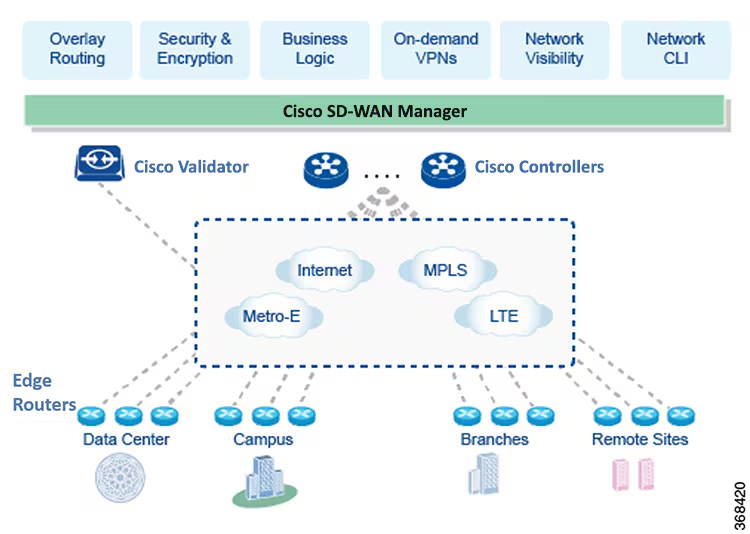
Cisco Talos separately said a cluster it tracks as UAT-11473 exploited CVE-2026-20127 to bypass authentication on Cisco SD-WAN Catalyst Controllers and install a custom framework called KeyDrift. Talos assessed with high confidence that the cluster’s infrastructure overlapped substantially with Silent Train, while stopping short of saying UAT-11473 and Volt Typhoon were the same actor.
KeyDrift injected into control-plane processes, persisted on controllers and could collect session metadata and what Talos assessed to be data-plane key material. Cisco said the activity targeted space and satellite services, defense and aerospace technology, and policy research. The company released patches and urged defenders to look for post-compromise activity rather than treating patching alone as proof that a network was clean.
Lumen said the most frequently observed U.S. victim locations were Hawaii, California and Texas, and assessed the pattern as consistent with maintaining access that could be useful during an Indo-Pacific crisis. That remains a vendor assessment: the public report does not name the victim organizations or disclose the underlying telemetry, limiting independent scrutiny of the attribution and scale.
Lumen and Cisco are primary vendor researchers. Help Net Security independently reported the disclosures, but the technical findings derive from those researchers. Victim identities and underlying telemetry are not public. Cisco found infrastructure overlap and did not equate UAT-11473 with Volt Typhoon. A focused search found no current Chinese response to the October 2026 disclosures; China has previously rejected U.S. Volt Typhoon attribution.
Sources & further reading
- Silent Train: uncovering Volt Typhoon's operational framework for zero-day exploitation and strategic accessLumen Black Lotus Labs / original threat research
- Inside KeyDrift: Analyzing historical UAT-11473 activity on Cisco SD-WANCisco Talos / original threat research
- Volt Typhoon targeted enterprise control planes via ever-changing Silent Train relay networkHelp Net Security / original security reporting
- Researchers uncover Volt Typhoon’s covert, ephemeral networkCyberScoop / original cybersecurity reporting
SPY REGISTER MEMBERSHIP
Stay on the case.
Follow this story through the case files, read The Brief and keep your own saved reports.
$6.67 a month equivalent · $80 billed annually. Or $8 monthly.
Get the member edition →Renews automatically. Cancel renewal online.